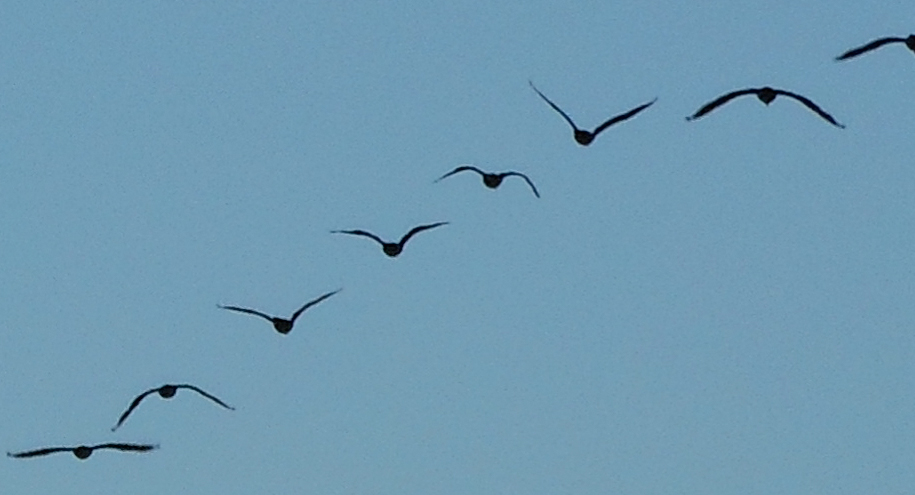
A classroom of kids, a symphony orchestra of musicians, and a flock of birds in flight. What do these three have in common? Groups of individual actions in organized activity each with a leader directing, controlling, cajoling, motivating, supporting and directing the individual as well as the collective operations of the group into a cohesive successful whole.
For the flock of birds, the successful end result is a coordinated operation, flying in a V formation for efficiency.
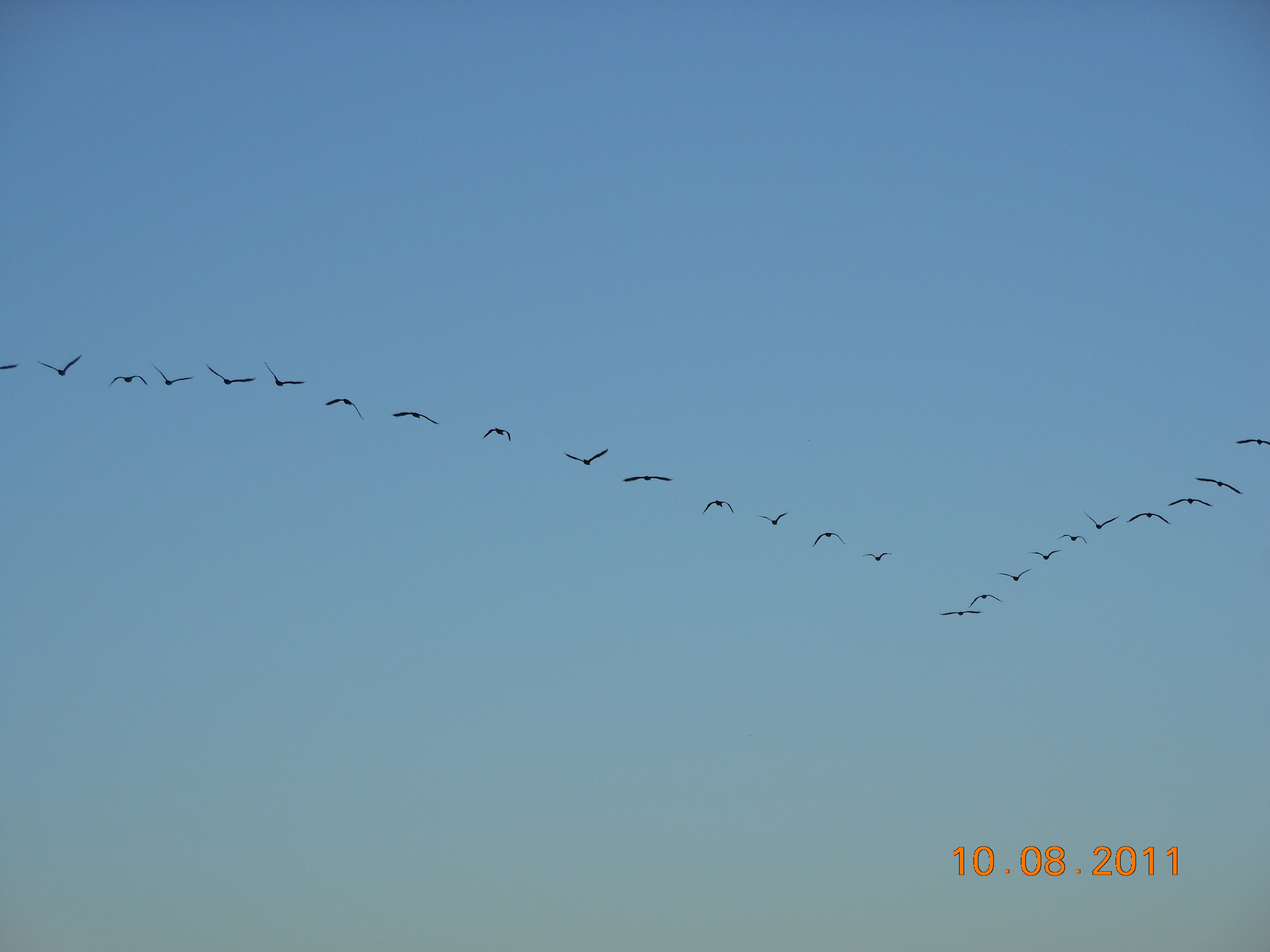
But look closer… each one is doing his/her own thing.

Individual moves, but still part of the organized whole – still in that V formation.
There’s a leader of the pack, leading but not worried about controlling each individual action because the leader knows how to moderate his/her own energies, understanding when to step back and let someone else in the group take the lead.
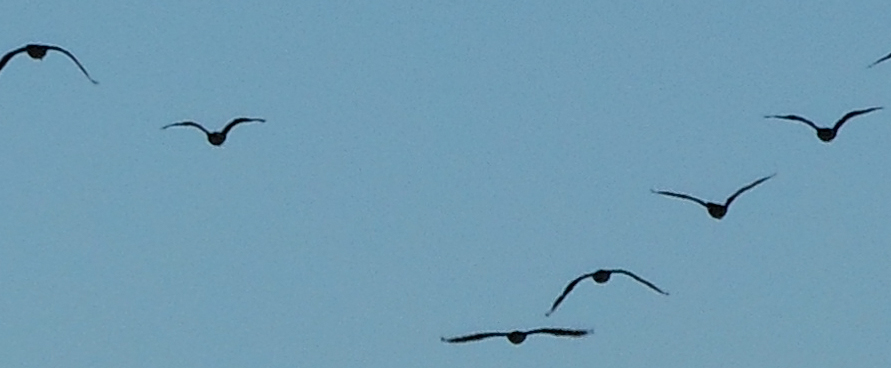
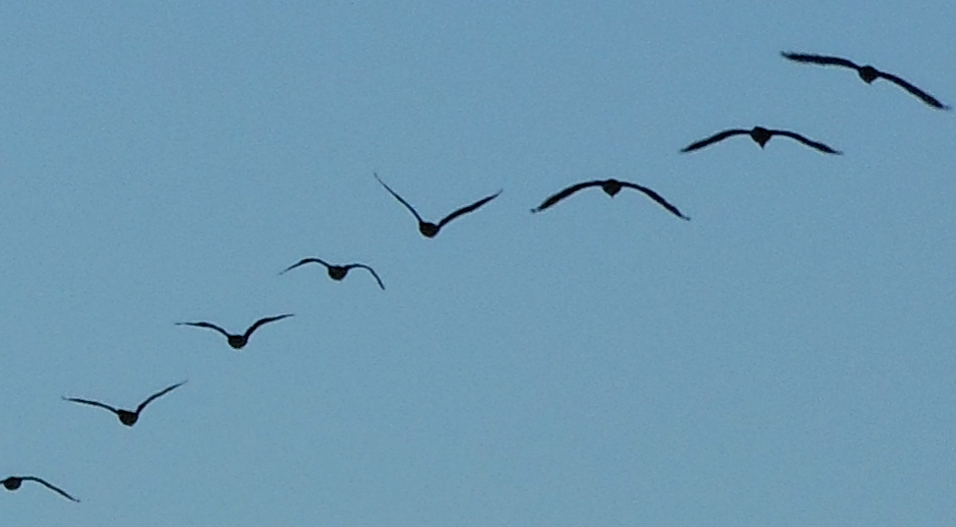
In the section of the photo to the right, the leader is at the bottom, center. In the photo below, the leader appears at the bottom, but is out front leading. The leader is not concerned with controlling the individual action of each bird, but with the overall formation that will provide efficient wind protection and lift for all to fly well. Each knows his or her script, and plays his or her individual instrument the way it needs to be played so that the final outcome is beneficial for all. Engrained in their DNA, is an understanding of how each individual action works together for the benefit of all the members of the group. They are aware of each other, they are listening to each other, and are supporting each other in maintaining the group goal, while yet being responsible for their own actions. This is Organisational Learning. Individual entities/organisms, working and learning from each other for the good of the whole.
The leader is a conductor, a coordinator, a facilitator, who doesn’t confuse leading with false notions of power and control, at the expense of stifling individual action.
Classrooms, like orchestras and flocks of birds, need good leaders who understand that organizations learn from the individuals and groups that make up that organization. There is a systematic approach to continual learning within.
There is a comittment to learning on an organizational as well as an individual level. There is Organizational Learning. This requires leaders who are comfortable leading and coordinating without resorting to militaristic control and the stifling of the individual styles and creativity of each, whether a musician in the orchestra, a bird in the flock or a child in the class. Steve Jobs allowed and encouraged individuality and creativity to come from all corners of his organization, knowing it would be good for the whole.
Like the conductor of the symphony orchestra, the classroom teacher must know the music score inside out, must know with absolute certainty what and when each instrument must play, and help guide the entire classroom community, so that the final result is one of success for all. Each one has to be allowed to sing his or her own song. Individual creativity and needs aren’t sacrificed at the altar of group goals.
Working within the group mores, does not necessarily mean ignoring the needs and creative voices of the individual members of the group.
Kicking kids out of class or out of school in an attempt to teach them to conform is a failed policy. It helps neither the child, nor the society.
For schools and classrooms to work well, there must be organization and classroom management. But it takes a skillful teacher and conductor to encourage the individual creativity and needs of each child, while also guiding the entire flock successfully throughout the school year. It can be done, with support. Both the children and their teachers need support.
The classroom teacher needs the support of every member of her team. That team includes students, families, fellow teachers and school administrators. Like that lead bird, the teacher needs to know that (s)he can pull back and catch her breath when (s)he is overwhelmed and can fly no further. (S)he must have others on whom she can depend.
The entire classroom and school organization must engage in organizational learning, learning from and supporting each other individually and as a total organization.
We only win when everyone wins.
The concert is a success when every member of the orchestra played well and the whole came together under the conductor’s baton. The birds in flight move more efficiently when they do their own individual thing while maintaining their V formation.
What is it that each individual child in the classroom needs to know so that they too can do their own thing, grow and thrive as wonderful creative individuals and not run afoul of the rules and regulations of the classroom and school? There is room for both the individual dance and for the coordinated organised group output. Successful organizations support both.
It takes time, and patience and a willingness to understand that each child brings his or her own gift to the classroom, and that there needs to be a place where that gift is respected and revered. It is in that place of reverence for the individual, that the collective, the whole, the flock in flight, the orchestra, the classroom, the school… can begin to find its successful and rightful place .
 All About Learning
Wonderful analogy! Does the bird in the leader position ever switch places with another bird? Just as students can sometimes take on the role of teachers and change the traditional teacher-student hierarchy, I wonder if birds can have a fluid concept of leader.
They absolutely do switch out and support each other. When the lead bird gets tired, (s)he drops back into the formation and another takes the lead. It is the hardest position to be in, because the lead bird is flying directly into the wind. Imagine if teachers had someone else to step in for them when they were out of energy? And certainly, the kids learn to assume different roles within the whole.
Very interesting!
You would also find ” Education on Trial ” by Nathan Rutstein an excellent read !